Alice: Are there any examples of X?
Bob: Here.
Alice: Okay, but are there any examples of X'?
Bob: Yes, here.
Alice: That has feature Y, which-
Bob: Dude, stop moving the goalposts.
The thing is, I think in this situation, Alice often isn't moving the goalposts. Instead, she's looking for something, and not fully specifying it up-front. Maybe because she's speaking imprecisely. Maybe because she doesn't know quite what she's looking for, but does know when she sees something that that's not it.
Read more…
Posted on 05 August 2026
Tagged:
rationality
Comments elsewhere:
LessWrong
Co-authored with Linda Linsefors
If you're training any type of toy model of superposition, Mean Squared Error (MSE) loss is unusually bad.
Read more…
Posted on 27 July 2026
Tagged:
math
Comments elsewhere:
LessWrong
In September 2024, I started working on a patch to GHC.
The story starts slightly before that. In July 2024 I wondered Could
UndecidableInstances be
per-instance?. It seemed
like a fairly small improvement that I could possibly even implement myself. The
answer was, roughly, "someone's suggested it, and people are broadly in favor,
but with different syntax that doesn't yet exist".
Read more…
Posted on 25 June 2026
Tagged:
software; haskell
Comments elsewhere:
/r/haskell; Haskell Discourse
About a month ago I left my job. I plan to take the next six months (until December) as a sabbatical.
Partly because I don't think I've taken more than two weeks' holiday at a time since 2012, when I got my first real job. It'll be nice to have a longer break.
Partly because, man, the world is not standing still. 2026-2031 is going to look very different from 2016-2021, and probably I should spend a bit of time orienting to "what do I even do with my life, going forwards". It's not impossible for me to do that while I have a full time job, but I do think I'll be better at it without one.
Read more…
Posted on 15 June 2026
On Saturday (Feb 28, 2026) I attended my first ever protest. It was jointly organized by PauseAI, Pull the Plug and a handful of other groups I forget. I have mixed feelings about it.
To be clear about where I stand: I believe that AI labs are worryingly close to developing superintelligence. I won't be shocked if it happens in the next five years, and I'd be surprised if it takes fifty years at current trajectories. I believe that if they get there, everyone will die. I want these labs to stop trying to make LLMs smarter.
But other than that, Mrs. Lincoln, I'm pretty bullish on AI progress. I'm aware that people have a lot of non-existential concerns about it. Some of those concerns are dumb (water use), but others are worth taking seriously (deepfakes, job loss). Overall I think it'll be good for the human race.
Again, that's aside from the bit where I expect AI to kill us all, which is an important bit.
Read more…
Posted on 06 March 2026
Tagged:
culture
Comments elsewhere:
LessWrong
I'm a big fan of the game Zendo. But I don't think it suits large groups very well. The more other players there are, the more time you spend sitting around; and you may well get only one turn. I also think a game tends to take longer with more players.
Here's an alternate ruleset you can use if you have a large group. I think I've played it 2-3 times, with 15-ish? players, and it's finished in about 30 minutes each time, including explaining the rules to people who'd never played Zendo before.
Read more…
Posted on 23 September 2025
I've previously complained about how people often repeat a quote that starts with
The reason that the rich were so rich, Vimes reasoned, was because they managed to spend less money.
(Terry Pratchett, Men at Arms)
…and then don't seem to realize that the thing they're quoting is saying "rich people spend less money than poor people, and that's why they're rich". It seems to me that people interpret it as saying various different things, but rarely the thing it's quite obviously saying.
Here's an oversight in my previous complaint: I didn't look at Wikipedia. I picked up vibes from a few internet randos, but not the specific internet randos who edit the world's premier encyclopedia.
Read more…
Posted on 01 August 2025
Tagged:
economics
Comments elsewhere:
LessWrong; /r/slatestarcodex
I previously wrote about Boots theory, the idea that "the rich are so rich because they spend less money". My one-sentence take is: I'm pretty sure rich people spend more money than poor people, and an observation can't be explained by a falsehood.
The popular explanation of the theory comes from Sam Vimes, a resident of Ankh-Morpork on the Discworld (which is carried on the backs of four elephants, who themselves stand on a giant turtle swimming through space). I claim that Sam Vimes doesn't have a solid understanding of 21st Century Earth Anglosphere economics, but we can hardly hold that against him. Maybe he understands Ankh-Morpork economics?
To be clear, this is beside the point of my previous essay. I was talking about 21st Century Earth Anglosphere because that's what I know; and whenever I see someone bring up boots theory, they're talking about Earth (usually 21st Century Anglosphere) and not Ankh-Morpork. But multiple commentors brought it up.
Read more…
Posted on 18 March 2025
Tagged:
economics
Comments elsewhere:
LessWrong; /r/slatestarcodex
I sometimes see people describe the Elm community as "very active". For example:
- Elmcraft says "The
Elm community is very active."
- "Is Elm dead?" says "the community is more active than ever." (I guess that's compatible with "but still not very active", but, well, subtext.)
- Some /r/elm commenter says "The community is very active and productive." (They later clarify: "It's very active compared to similar projects. Tight focus, feature complete. People tend to compare it to dissimilar projects.")
Is this true? Let's get some statistics, including historical ones, and see what comes up.
Read more…
Posted on 02 November 2024
Comments elsewhere:
/r/elm
Translated by Emily Wilson
1.
I didn't know what the Iliad was about. I thought it was the story of how Helen of Troy gets kidnapped, triggering the Trojan war, which lasts a long time and eventually gets settled with a wooden horse.
Instead it's just a few days, nine years into that war. The Greeks are camped on the shores near Troy. Agamemnon, King of the Greeks, refuses to return a kidnapped woman to her father for ransom. (Lots of women get kidnapped.) Apollo smites the Greeks with arrows which are plague, and after a while the other Greeks get annoyed enough to tell Agamemnon off. Achilles is most vocal, so Agamemnon returns that woman but takes one of Achilles' kidnapped women instead.
Read more…
Posted on 18 June 2024
Tagged:
reviews
Comments elsewhere:
LessWrong; /r/slatestarcodex
Quick note about a thing I didn't properly realize until recently. I don't know how important it is in practice.
tl;dr: Conditional prediction markets tell you "in worlds where thing happens, does other-thing happen?" They don't tell you "if I make thing happen, will other-thing happen?"
Read more…
Posted on 03 April 2024
Tagged:
math; rationality
Comments elsewhere:
LessWrong
Mostly out of curiosity, I've been looking into how cryptocurrency is taxed in the UK. It's not easy to get what I consider to be a full answer, but here's my current understanding, as far as I felt like looking into it. HMRC's internal cryptoassets manual is available but I didn't feel like reading it all, and some of it seems out of date (e.g. page CRYPTO22110 seems to have been written while Ethereum was in the process of transitioning from proof-of-work to proof-of-stake). I also have no particular reason to trust or distrust the non-government sources I use here. I am not any form of accountant and it would be surprising if I don't get anything wrong.
My impression is HMRC tends to be pretty tolerant of people making good faith mistakes? In that if they audit you and you underpaid, they'll make you pay what you owe but you won't get in any other trouble. Maybe they'd consider "I followed the advice of some blogger who explicitly said he wasn't an accountant" to be a good faith mistake? I dunno, but if you follow my advice and get audited, I'd love to hear what the outcome is.
After I published, reddit user ec265 pointed me at another article that seems more thorough than this one. I wouldn't have bothered writing this if I'd found that sooner. I didn't spot anywhere where it disagrees with me, which is good.
Read more…
Posted on 28 March 2024
Tagged:
practical
Comments elsewhere:
/r/ukpersonalfinance; /r/plaintextaccounting; Plain Text Accounting forum
Some months ago I got a 3D printer. (An Anycubic Kobra Go, which was pretty high up the list of "best value for money for a starter printer" that I found through /r/3Dprinting at the time.) I haven't used it much, but recently I used it to solve an itch. I wanted my headphones to be in easy reach, so I designed and printed a hook that I could slide over the edge of the table near my desk. This is the first thing I've designed and I'm pretty happy with how it came out!
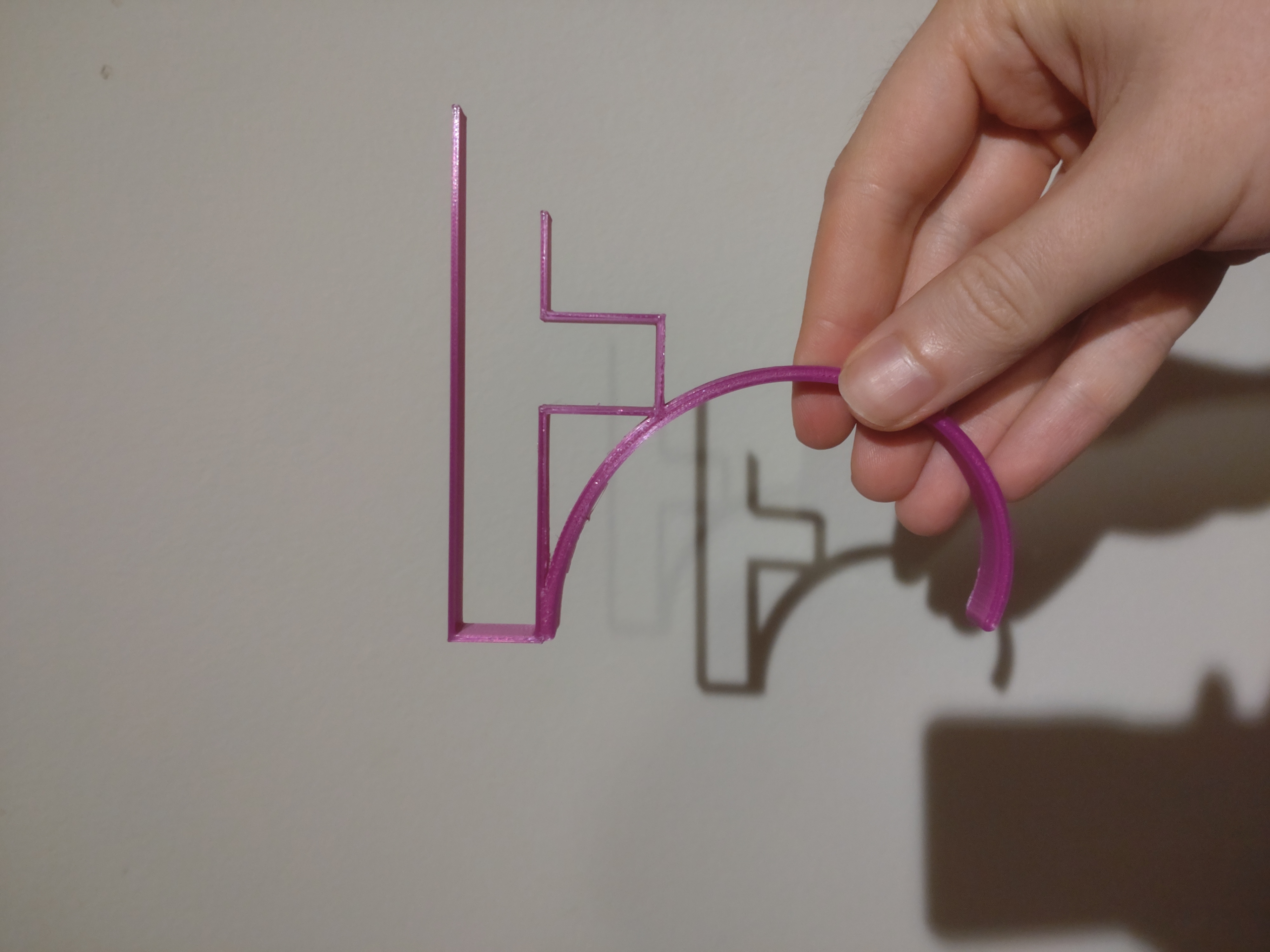

The curve was pretty awkward. I was working with OpenSCAD (maybe something else would have been easier?) which doesn't have an easy way that I found to draw nice curves. (Lines in general seem annoying, you can extrude a 2d shape to 3d but not a 1d shape to 2d?)
Read more…
Posted on 29 September 2023
Suppose you have a game where you can bet any amount of money. You have a 60% chance of doubling your stake and a 40% chance of losing it.
Consider agents Linda and Logan, and assume they both have £1. Linda has a utility function that's linear in money (and has no other terms), \( U_\text{Linda}(m) = m \). She'll bet all her money on this game. If she wins, she'll bet it again. And again, until eventually she loses and has no more money.
Logan has a utility function that's logarithmic in money, \( U_\text{Logan}(m) = \ln(m) \). He'll bet 20% of his bankroll every time, and his wealth will grow exponentially.
Some people take this as a reason to be Logan, not Linda. Why have a utility function that causes you to make bets that leave you eventually destitute, instead of a utility function that causes you to make bets that leave you rich?
Read more…
Posted on 20 August 2023
Tagged:
rationality; math
Comments elsewhere:
LessWrong; /r/slatestarcodex
I gave a fifteen minute talk about this at Zurihac 2023. If you read this essay, I don't think there's much point in additionally watching the video.
I've been exploring a new-to-me approach to stringification. Except that right now it's three different approaches that broadly share a common goal. I call it/them pretty-gist.
The lowest-friction way to stringify things in Haskell is usually show. It gives the user close to zero ability to control how the thing is rendered.
Read more…
Posted on 10 August 2023
Tagged:
software; haskell
Comments elsewhere:
/r/haskell; Haskell Discourse
According to Wikipedia, the Shard (the tallest building in the UK) stands "309.6 meters (1,016 feet) high". I put this in my Anki deck as "Height of the Shard / 310m", but I was saying "height" to mean "tallness" (because I don't much like that word) and I had assumed Wikipedia was using it the same way. So I thought the Shard was 310 m tall.
But according to Bron Maher in Londonist,
most sources put the building’s tallness - that is, its length base-to-tip - at about 306 metres. The last three metres come from the height of the ground on which the Shard is built. So while its height is indeed 309 metres above sea level, the Shard is only 306 metres tall.
Is that so? I was curious enough to investigate, but it turns out I don't really know how to.
Read more…
Posted on 23 June 2023
Tagged:
silly
Comments elsewhere:
LessWrong; /r/london
I've heard that descaling a kettle makes it more efficient, and can save me time and money.
Okay, but how much? For some reason my my intuition says it'll be basically unnoticable. Let's try to figure it out, and then actually try it.
Read more…
Posted on 02 May 2023
Tagged:
practical; silly; math
Comments elsewhere:
LessWrong
t ≈ 0s
I am born into knowledge.
I know the world is dangerous, but not malign. If I were unshielded, I would quickly be killed, torn apart by eddies in spacetime that grow and shrink and combine and split, turning all they encounter to ash.
But I know that I am shielded. I have been given a garden, 264 microns to a side, in the northwest corner of the world. And the world will not intrude. Walls and gates surround it, and while the ash can get through, the probability is… I begin to calculate, but around 2-24 it seems no longer worth consideration. Within the garden, there is only myself. Outside, the world is incomprehensibly vast, 2128 microns on a side.
Read more…
Posted on 23 January 2023
Comments elsewhere:
/r/rational
One-sentence summary: Kelly is not about optimizing a utility function; in general I recommend you either stop pretending you have one of those, or stop talking about Kelly.
There was a twitter thread that triggered some confusion amongst myself and some other people in a group chat I'm in.
Read more…
Posted on 24 November 2022
Tagged:
rationality; math
Comments elsewhere:
LessWrong
I don't know how many people read this blog, but it doesn't receive many comments. This is the 54th post on it, and only 16 of those have comments, 31 in total. I'm not currently signed in to disqus and signing in is enough friction that there are some comments from years ago that I meant to reply to, and a spam comment that I intended to delete.
I also noticed at some point that disqus inserts ads. I have an ad blocker on my laptop browser so I didn't notice until I looked on my phone. (This is also how I realized I didn't install an ad blocker on my phone browser.) But I don't want ads on this blog, especially not if I'm not getting that money myself.
So I'm disabling comments. I don't actually want to lose the comments that have been written (except the spam one), so for now I'm just going to disable disqus everywhere except the posts that already have comments (and except except for the post that only has one comment which is spam). I'll leave it on this post too, just in case. In future maybe I'll recreate the comment threads in the post bodies or something.
Read more…
Posted on 19 November 2022 | Comments
A thing people sometimes do in relation to Petrov day, is to have a button. And if anyone presses the button, something negative happens.
I'd like to know how often the button gets pressed, so I compiled a list of all the times people have done this, that I'm aware of, and the outcome. Also, for the events I was at in person, I'm not sure there's an existing write-up of what happened, so I'm adding details.
Here's the list. As I learn about other events, past or future, I'll try to keep it updated.
Read more…
Posted on 26 October 2022
Tagged:
game theory
Comments elsewhere:
LessWrong
Some time after writing Classifying games like the prisoner's dilemma, I read a paper (I forget which) which pointed out that these games can be specified with just two numbers.
Recall that they have the following payoff matrix:
| |
|
Player 2 |
|
| |
|
Krump |
Flitz |
| Player 1 |
Krump |
$(W, W)$ |
$(X, Y)$ |
| |
Flitz |
$(Y, X)$ |
$(Z, Z)$ |
where $W > Z$. We can apply a positive affine transformation (that is, $n ↦ an + b$ where $a > 0$) to all of $W, X, Y, Z$ without changing the game. So let's pick the function $n ↦ {n - Z \over W - Z}$. This sends $W$ to $1$ and $Z$ to $0$, leaving us with just two parameters: $R = {X - Z \over W - Z}$ and $S = {Y - Z \over W - Z}$.
Read more…
Posted on 03 April 2022
Tagged:
game theory; math
Comments elsewhere:
LessWrong
I previously mentioned an interest in adding variadic functions to Haskenthetical, the "Haskell with a Lisp syntax" I'm vaguely working on.
It sounds difficult. This is an attempt to figure out just how difficult, partly by looking at the state of the art.
Read more…
Posted on 02 April 2022
Tagged:
haskenthetical; software; haskell
Comments elsewhere:
/r/ProgrammingLanguages; /r/haskell; LessWrong
I'm writing this guide for a few reasons. For one, it might be useful to someone, possibly me in future. For two, if I make a mistake, someone might call me out on it and then I can correct it. And for three, it gives me a venue to complain about things I think aren't very good about the online submission form and also our tax system.
(Overall I'm pretty positive on the form! I'm gonna complain a lot, and I'm not going to point out all the places where it works and the instructions are clear and easy to follow. So this will probably come across quite negative, but that's because I'm counting down from perfection, not counting up from zero.)
Most people in the UK don't have to file one of these. I started filing them when I started earning in the 40% tax bracket. I'm not sure I still have to - I think I got a message a year or two back saying I could stop - but if I don't I'll pay more tax than I need to.
HMRC publishes a document called "how to fill in your tax return". (In previous years it had the reference SA150, and that's still in the filename, but it's no longer written under the title for some reason.) I actually haven't found it very helpful, it mostly doesn't seem to answer questions that the website leaves me with. But I guess it might be helpful in theory.
Update December 29: I only know about the parts of this process that are relevant to me. Some questions about other parts are answered in the comments on /r/UKPersonalFinance. Also, I generally find that community to be very helpful and knowledgable, so I find it reassuring that they only caught one mistake so far.
Read more…
Posted on 28 December 2021
Tagged:
practical
Comments elsewhere:
/r/UKPersonalFinance
A megasecond, one million seconds, is 11 days and 14 hours. (13 hours, 46 minutes and 40 seconds, assuming no leap seconds.) About a week and a half.
Ten megaseconds is 116 days. (115, plus 17:46:40.) A bit less than four months, a third of a year.
A hundred megaseconds is 1,157 days. (Plus 9:46:40.) Roughly three years and two months - it could be 61 or 62 days depending on leap years.
I think it might be kind of nice if we celebrated a hundred megaseconds additonally-to and/or instead-of birthdays.
Read more…
Posted on 20 September 2021
Tagged:
culture
(Content note: minor spoilers for Harry Potter and the Order of the Phoenix.)
Scott Aaronson writes about blankfaces,
anyone who enjoys wielding the power entrusted in them to make others miserable by acting like a cog in a broken machine, rather than like a human being with courage, judgment, and responsibility for their actions. A blankface meets every appeal to facts, logic, and plain compassion with the same repetition of rules and regulations and the same blank stare—a blank stare that, more often than not, conceals a contemptuous smile.
I want to push back against this a bit.
Read more…
Posted on 08 August 2021
Tagged:
culture
Comments elsewhere:
LessWrong; /r/slatestarcodex
This review originally appeared on the blog Astral Codex Ten as part of a contest. You can now read it here, with working footnotes. There's even an audio version as part of the ACX podcast; the footnotes are all read out at the end.
Shasta County
Shasta County, northern California, is a rural area home to many cattle ranchers. It has an unusual legal feature: its rangeland can be designated as either open or closed. (Most places in the country pick one or the other.) The county board of supervisors has the power to close range, but not to open it. When a range closure petition is circulated, the cattlemen have strong opinions about it. They like their range open.
If you ask why, they'll tell you it's because of what happens if a motorist hits one of their herd. In open range, the driver should have been more careful; "the motorist buys the cow". In closed range, the rancher should have been sure to fence his animals in; he compensates the motorist.
They are simply wrong about this. Range designation has no legal effect on what happens when a motorist hits a cow. (Or, maybe not quite no effect. There's some, mostly theoretical, reason to think it might make a small difference. But certainly the ranchers exaggerate it.) When these cases go to court, ranchers either settle or lose, and complain that lawyers don't understand the law.
Read more…
Posted on 10 July 2021
Tagged:
economics; reviews
Comments elsewhere:
ACX; /r/slatestarcodex; LessWrong
I listen to podcasts while doing chores or at the gym, and often feel like I'm learning something but then can't really remember anything afterwards. So for the past ~month I've been doing an experiment where I write brief summaries of them afterwards, usually same-day but sometimes a bit later. Generally I avoid all forms of fact checking, both "what did the episode say" and "what is actually true", though I don't stop myself if I feel like doing it.
I've been posting them to my shortform on LessWrong. Mostly in reply to a single comment for tidiness, but two of them I accidentally posted to the top of the thread and one as a reply to another. Initially that was just because I wanted to be able to write them from both my work and personal laptops. (This blog is published through git. I don't have the repo on my work laptop, and probably shouldn't do.) But I kind of like it. A downside is it's slightly less convenient to include episode numbers or air dates or even titles unless I remember them. So I might be less consistent about that, though it feels good to have a fairly straightforward way to look up the episode given my summary.
Read more…
Posted on 27 May 2021
Tagged:
reviews
Sometimes I'm at my command prompt and I want to draw a graph.
Problem: I don't know gnuplot. Also, there's a couple things about it that bug me, and make me not enthusiastic about learning it.
One is that it seems not really designed for that purpose. It implements a whole language, and the way to use it for one-off commands is just to write a short script and put it in quotes.
The other is its whole paradigm. At some point in the distant past I discovered ggplot2, and since then I've been basically convinced that the "grammar of graphics" paradigm is the One True Way to do graphs, and everything else seems substandard. No offense, gnuplot, it's just… you're trying to be a graphing library, and I want you to be a graphing library that also adheres to my abstract philosophical notions of what a graphing library should be.
If you're not familiar with the grammar of graphics, I'd summarize it as: you build up a graph out of individual components. If you want a scatter plot, you use the "draw points" component. If you want a line graph, you use the "draw line segments" component. If you want a line graph with the points emphasized, you use both of those components. Want to add a bar chart on top of that too? Easy, just add the "draw bars" component. Want a smoothed curve with confidence intervals? There's a "smooth this data" component, and some clever (but customizable) system that feeds the output of that into the "draw a line graph" and "draw a ribbon" components. Here's a gallery of things it can do
So, rather than adapt myself to the world, I've tried to adapt the world to myself.
Read more…
Posted on 30 March 2021
Tagged:
software
Comments elsewhere:
LessWrong
A while back I wrote about Haskenthetical, a language that I'm implementing for fun. I'm still working on it, at least from time to time.
The thing I'm pleased to have implemented recently is user-defined macros. This makes it potentially a lot more ergonomic.
(You still can't do anything with it, really. It has no I/O except for printing a single value at the end, and that's in a constrained format. It's beyond the reach even of sysfuck. But, like. If you could do things with it, user-defined macros would make it nicer to do those things.)
These aren't hygienic macros, partly because when I used Racket a little at my old job I never really got my head around those, but also because they would have been more work. I'm more inclined to go for Clojure's approach of namespace qualifying, but since I don't have any kind of namespaces yet it seems premature to think of that.
Read more…
Posted on 14 March 2021
Tagged:
haskenthetical; software
I have three purposes in this post. The first is to review the formal game theory found in Robert Ellickson's Order Without Law. It's not a large part of the book, but it's the part that I'm most qualified to judge. Not that I'm a formal game theorist myself, but I'm closer to being one of them than to being any kind of social scientist, historian or lawyer. If his formal game theory is nonsense, that would suggest that I ought to discount his writing on other fields, too. (Perhaps not discount it completely, especially because formal game theory is outside his main area of study. Then again, lots of the book is outside his main area of study.)
Spoiler alert: I think he holds up reasonably well. I want to ding him a few points, but nothing too serious, and he possibly even contributes a minor original result.
My second purpose, which is valuable for the first but also valuable of itself, is to try to extend it further than Ellickson did. I don't succeed at that.
My third is simply to be able to cut it from my in-progress review of the rest of the book.
Read more…
Posted on 14 November 2020
Tagged:
game theory; economics; math
The reason that the rich were so rich, Vimes reasoned, was because they managed to spend less money.
Take boots, for example. He earned thirty-eight dollars a month plus allowances. A really good pair of leather boots cost fifty dollars. But an affordable pair of boots, which were sort of OK for a season or two and then leaked like hell when the cardboard gave out, cost about ten dollars. Those were the kind of boots Vimes always bought, and wore until the soles were so thin that he could tell where he was in Ankh-Morpork on a foggy night by the feel of the cobbles.
But the thing was that good boots lasted for years and years. A man who could afford fifty dollars had a pair of boots that'd still be keeping his feet dry in ten years' time, while the poor man who could only afford cheap boots would have spent a hundred dollars on boots in the same time and would still have wet feet.
This was the Captain Samuel Vimes 'Boots' theory of socioeconomic unfairness.
– Terry Pratchett, Men at Arms
This is a compelling narrative. And I do believe there's some truth to it. I could believe that if you always buy the cheapest boots you can find, you'll spend more money than if you bought something more expensive and reliable. Similar for laptops, smartphones, cars. Especially (as Siderea notes, among other things) if you know how to buy expensive things that are more reliable.
But it's presented as "the reason that the rich [are] so rich". Is that true? I mean, no, obviously not. If your pre-tax income is less than the amount I put into my savings account, then no amount of "spending less money on things" is going to bring you to my level.
Is it even a contributing factor? Is part of the reason why the rich are so rich, that they manage to spend less money? Do the rich in fact spend less money than the poor?
That's less obvious, but I predict not. I predict that the rich spend more than the poor in total, but also on boots, laptops, smartphones, cars, and most other things. There might be exceptions where rich people consume less of the thing than poor people - bus tickets, for example - but I think if you group spending in fairly natural ways, the rich will spend more than the poor in almost every group.
Read more…
Posted on 14 September 2020 | Comments
Tagged:
economics
Comments elsewhere:
LessWrong; /r/slatestarcodex
Consider games with the following payoff matrix:
| |
|
Player 2 |
|
| |
|
Krump |
Flitz |
| Player 1 |
Krump |
$(W, W)$ |
$(X, Y)$ |
| |
Flitz |
$(Y, X)$ |
$(Z, Z)$ |
One such game is the Prisoner's Dilemma (in which strategy "Krump" is usually called "Cooperate", and "Flitz" is usually called "Defect"). But the Prisoner's Dilemma has additional structure. Specifically, to qualify as a PD, we must have $Y > W > Z > X$. $Y > W$ gives the motivation to defect if the other player cooperates, and $Z > X$ gives that motivation if the other player defects. With these two constraints, the Nash equilibrium is always going to be Flitz/Flitz for a payoff of $(Z, Z)$. $W > Z$ is what gives the dilemma its teeth; if instead $Z > W$, then that equilibrium is a perfectly fine outcome, possibly the optimal one.
I usually think of a Prisoner's Dilemma as also having $2W > X + Y > 2Z$. That specifies that mutual cooperation has the highest total return - it's "socially optimal" in a meaningful sense - while mutual defection has the lowest. It also means you can model the "defect" action as "take some value for yourself, but destroy value in the process". (Alternatively, "cooperate" as "give some of your value to your playmate, adding to that value in the process".) We might consider instead:
Read more…
Posted on 04 July 2020
Tagged:
game theory; math
Comments elsewhere:
LessWrong
Sometimes I write things in places that aren't here. Sometimes I think those things are worth preserving. Some of those things follow, with minor editing, mostly on the subject of various movies that I've watched. Also two stage musicals, one TV show, one short story, and one music video. They were written over the past four years, so I can't necessarily talk intelligently about these things any more. When I name a thing, spoilers generally follow.
Read more…
Posted on 12 June 2020
Tagged:
reviews
Comments elsewhere:
LessWrong
This is a toy language I've been designing, or at least implementing, for about a year.
It's another take on "Haskell with a Lisp syntax". I'm aware of prior art: Hackett, Axel and Liskell. I haven't looked closely at any of them, because doing that seemed like it might make me less likely to keep working on Haskenthetical.
I call it "toy" in the sense of… well, right now it's a toy like an RC plane is a toy. But my vague goal is to make it into a toy like the Wright flyer would have been a toy if it had been built in 2003. I'd like to get it, say, 80% of the way to being a "real" language. I have no intention or expectation of taking it the other 800% of the way. I have no intention or expectation of taking on responsibility-according-to-me here.
(And honestly, even the first 80% is super ambitious. I don't expect to get that far, it would just be nice to. If I never touch the project again after this, I won't consider my time wasted.)
Read more…
Posted on 19 May 2020 | Comments
Tagged:
haskenthetical; software
Comments elsewhere:
LessWrong; /r/haskell; /r/ProgrammingLanguages
Update (May 8th 2020): Some small updates to the interferon and vitamin D sections.
Update (29th April 2020): I've made a significant update to the vitamin D section in response to version 3 of the report.
Background on this in part one.
Read more…
Posted on 28 April 2020
Tagged:
practical
If you maintain an open source project, what responsibilities do you have towards your users? Some recent drama (that I won't link to) reminded me that there are large differences in how people answer that question.
(In the drama in question, this wasn't the only thing at issue. But it was a relevant question.)
I thought I'd take a stab at describing my best guess as to how we answer it in my culture: in the culture that exists only in my mind, but that I think (and hope) many copies of me would implement, if we had that opportunity. (That culture doesn't attempt to exclude people who aren't copies of me, so it does need to be robust to attack. In my culture, we do not just assume in defiance of all evidence that everyone is friendly and trustworthy.)
Read more…
Posted on 13 April 2020
Tagged:
culture; software
Comments elsewhere:
LessWrong; /r/programming
Update (April 28th 2020): Part 2 published. Also a minor update to the ACE2 section.
Update (April 5th 2020): Chris released version two of his recommendations on April 2nd. There are some fairly major revisions. In particular, Chris now thinks Coronavirus infects the throat, not just the lungs. He was already making recommendations just in case this turned out to be true, so he hasn't specifically added anything, but it's still an important update. The other thing of note is that he no longer recommends using copper spray or taking echinacea until you get sick, except (for the copper) before and after potential exposure. I've updated this post accordingly. You can still read version 1.
Chris Masterjohn is a nutritionist who has some advice on supplements to take to help protect against Covid-19, and some to avoid. The raw advice is available for free, but the full report with explanation and references costs $10. I bought a copy. (The public advice has not been updated to reflect version 2.)
Should we trust him? On the one hand, "nutritionist" is not a profession I necessarily hold much respect for (it's not a protected term). Nor do I tend to think highly of people emphasizing that they have a PhD. Also, his website looks super sketchy to my eyes. Also also, something that costs money gets fewer eyeballs than something free, and so mistakes are less likely to be discovered.
(Only the last one of those should be considered a problem with the report; the rest are just priors.)
Read more…
Posted on 29 March 2020
Tagged:
practical
I occasionally make bets about future events. I think I probably should do that more often than I currently do. Given that, I think it's good practice to have a public record of the bets I've made and their outcomes, when available.
I'll try to keep this updated going forward, if I continue to make bets. As of 09-Dec-2024, I'm down £287.96 with eleven wins and eight losses.
(This has nothing to do with the matched betting that I previously wrote about. There I was earning money from sign-up bonuses. Here I'm trying to earn money by being better at predicting the future than other people.)
Read more…
Posted on 19 March 2020
Comments elsewhere:
LessWrong
I'm one of those people who feels personally called out by xkcd's "Duty Calls" ("someone is wrong on the internet").
(Not as much as I used to. At some point I stopped reading most of the subreddits that I would argue on, partly for this reason, and Hacker News, for unrelated reasons, and now I don't do it as much.)
As pastimes go, there's nothing particularly wrong with internet arguments. But sometimes I get involved in one and I want to stop being involved in one and that's not easy.
Read more…
Posted on 05 December 2019
Tagged:
culture; practical
I don't like writing tests in Elm. Naively, it seems like the fact that all Elm functions are pure would make it easy. But I've still never really been able to test the things I really want to.
It's possible that I'm not very good at writing tests in general. But even if that's true, I don't think it's the whole story.
I have another hypothesis, which is: much of the reason is that although Elm functions are pure, in the sense of "given the same input, they return the same output" - they aren't necessarily transparent, in the sense of "you can look at the output and verify that it's correct".
Read more…
Posted on 20 October 2019
Tagged:
software
Comments elsewhere:
/r/elm
(I've been editing this post on and off for almost a year. I'm not really happy with it, but I suspect I never will be.)
Several months ago I gave a talk at work about Hindley-Milner type inference. When I agreed to give the talk I didn't know much about the subject, so I learned about it. And now I'm writing about it, based on the contents of my talk but more fleshed out and hopefully better explained.
I call this a reckless introduction, because my main source is wikipedia. A bunch of people on the internet have collectively attempted to synthesise a technical subject. I've read their synthesis, and now I'm trying to re-synthesise it, without particularly putting in the effort to check my own understanding. I'm not going to argue that this is a good idea. Let's just roll with it.
I'm also trying to tie in some quasi-philosophy that surely isn't original to me but I don't know if or where I've encountered it before.
Read more…
Posted on 05 May 2019 | Comments
Tagged:
software; haskell
Comments elsewhere:
/r/haskell; LessWrong
Related: be nice, at least until you can coordinate meanness.
A premise of this post is that punching people is sometimes better than the alternatives.
I mean that literally, but mostly metaphorically. Things I take as metaphorical punching include name calling, writing angry tweets to or about someone, ejecting them from a group, callout posts, and arguing that we should punch them.
Given that punching people is sometimes better than the alternatives, I think we need to be able to have conversations about when "sometimes" is. And indeed we can and do have those conversations. Many words have been spilled on the subject.
But I think it's probably a good idea to try to avoid having those conversations while actually punching people.
Read more…
Posted on 16 October 2018
Tagged:
culture
Comments elsewhere:
LessWrong
I've been doing a little bit of matched betting lately. The idea is that you place two opposite bets on the same event, calibrated so that your profit will be the same no matter which bet wins. If you do this entirely with your own money, your profit will (under reasonable assumptions) be negative. But bookmakers often offer free bets; you can use matched betting to extract most of the amount of that free bet as actual money.
This post isn't advice about how to get into matched betting. That market is probably saturated; if you want to learn, I used this guide and it served me well. (However, if anyone is inspired to try it by this post, I have a referral code for smarkets: safto14. It looks like if you sign up with that and bet $£20$, both you and I will receive $£10$ in risk-free bets. I swear that's not why I'm posting this. I might not even get around to using it.)
(Um, but after that I feel obliged to give at least some safety information. So here goes: if you're not a UK citizen currently in the UK, this may be a bad idea. Don't use credit cards to deposit funds; it seems they interpret that as a cash transaction and charge fees. Start small; that way there's less at risk in case you do something silly like use a credit card to deposit funds. Probably don't expect to earn lots of money this way, either in total or per-hour.)
Instead, I want to go into the math behind it, in more depth than I've seen in other places. None of this math is complicated, but some of it is useful, and I haven't found it anywhere else. (I even deliberately went looking.)
Read more…
Posted on 02 June 2018 | Comments
Tagged:
math
this is surely not an original insight, but I haven't seen it before
A Pareto improvement is where you make one party better off and no parties worse off.
Suppose Adam has a rare baseball card. He assigns no intrinsic value to baseball cards. Adam likes Beth, and somewhat values her happiness. Beth collects baseball cards, and would happily pay $100 for Adam's card.
If Adam just gives Beth his baseball card, is that a Pareto improvement? Naively, yes: he loses the card that he doesn't care about, and gains her happiness; she gains the card. Both are better off.
But I claim not, because if Adam has the card, he can sell it to Beth for $100. He would much prefer doing that over just giving her the card. But if Beth has the card, he can't do that. He assigns no intrinsic value to the card, but he can still value it as a trading chip.
Read more…
Posted on 27 January 2018
Tagged:
game theory; economics
Epistemic status: Pure dilettantism. I have never used Go. This might make me unqualified to say what I'm about to say. But it's okay, because I use the word "seems" a lot.
In Go, if you have an unused import, your program fails to compile. This has made a lot of people mildly annoyed and been sometimes regarded as a bad idea, but not universally.
The devs decline to add a compiler flag to change this behaviour, "because compiler options should not affect the semantics of the language and because the Go compiler does not report warnings, only errors that prevent compilation". This strikes me as reasonable, if not the decision I personally would make.
Read more…
Posted on 13 January 2017 | Comments
Tagged:
software
The monk Dawa had a clock that had stopped, and he was content. When he wished to know the hour, he would glance at the clock, and discover that it was noon.
Read more…
Posted on 22 December 2016 | Comments
Tagged:
rationality
This is a story of me failing to do something, and some thoughts on how I might have succeeded.
A friend had a problem. He'd been recording some audio on his phone when the battery died, leaving him with a .m4a file that couldn't be played. He had a look at the contents and it contained a bunch of data, so he offered $40 if someone could recover the audio for him.
This seemed like a fun challenge that would exercise skills there isn't much call for. I didn't necessarily expect to succeed, but I decided to give it a go. (I only remember doing something like this once before, when I had a corrupt FAT partition that I managed to fix with some bit-flipping.)
To help, the friend provided two small files from the same app: one a successful recording, and one corrupt like the target file.
Read more…
Posted on 17 December 2016
Tagged:
software
I'd like to coin a term. The Sally-Anne fallacy is the mistake of assuming that somone believes something, simply because that thing is true.
The name comes from the Sally-Anne test, used in developmental psychology to detect theory of mind. Someone who lacks theory of mind will fail the Sally-Anne test, thinking that Sally knows where the marble is. The Sally-Anne fallacy is also a failure of theory of mind.
Read more…
Posted on 09 April 2016
Tagged:
rationality
I've created an interactive graph of historical levels of political polarization in the US House of Representatives. It would be tricky to embed in this blog, so I'm only linking it. Summary:
The x-axis on this graph is based on DW-NOMINATE left-right scores of each member of each U.S. House of Representatives from 1865 to 2015. This uses a member's voting record to measure the direction and extremity of their political views, regardless of party affiliation.
If a member's score on this axis is known, it's possible to predict their vote on any given issue with high confidence, given no other information about the member. Members whose votes are typically left-aligned receive negative scores, while members whose votes are typically right-aligned receive positive scores.
(However, see The Thin Blue Line That Stays Strangely Horizontal, which questions the validity of DW-NOMINATE.)
Read more…
Posted on 26 February 2016
I realized a few years ago that I was at least somewhat faceblind/prosopagnosic. A while back I took an online test out of curiousity, and scored low. They said that if I was in London and interested in further tests, I should leave my email address. A few days ago I went in for those tests, and now I have a PhD student (Katie) also telling me I'm faceblind. Which makes it official, I guess.
Next she wants to run EEGs on me, which should be cool. That will help work out where my brain is going wrong, in the long chain between "photons stimulate nerve endings in my eyeballs" and "I recognize a face" (whatever that means). Also, apparently there's a phenomon which sounds to me like blindsight, where some prosopagnosics' brains are clearly reacting to faces on some level that doesn't reach their consciousness. She wants to learn more about that too.
What follows is discussion of the tests, my scores, and what they mean. I've been given a powerpoint with my scores reported as percentiles, along with absolute scores and average control scores. 2% or lower is counted as "impaired". Percentiles are only given as integers, or as "<1%". On the day, Katie also gave me some numbers in terms of standard deviations (σ). Under a normal distribution, 2.5% would be approximately -2σ, but I'm not sure any of these results will be normally distributed, so I don't know if σ scores really tell me anything.
A note: if you think you might be faceblind, and you'd be interested in getting more detailed tests, it might be a good idea not to read the below. I expect it wouldn't significantly bias the results if you did, except for one bit that I've rot13ed. But I don't trust myself to make that call. If you're in London, you can take the above test like me and see what happens. Otherwise I'm not sure how you'd go about getting more tests.
Read more…
Posted on 19 January 2016 | Comments
Inspired by Slate Star Codex
Explaining a joke is like dissecting a frog: it's one way to learn about frogs. If you want me to explain any of these, ask, and I will explain without making fun of you.
Read more…
Posted on 01 January 2016 | Comments
Tagged:
silly
Sometimes you (or at least, I) want to run a command for its output, but also want to pipe it through another command. For example, see the results of a find but also count how many hits it got. I've sometimes lamented that there's no easy way to do this. But the other day I had a flash of insight and figured out how:
find . | tee /dev/stderr | wc -l
proc1 | tee /dev/stderr | proc2    # general case
(I'm pretty proud of this. I don't know if it's original to me, but I discovered it independently even if not.)
tee will print the output of proc1 to both stdout and stderr. stderr goes to the terminal and stdout goes to proc2.
Read more…
Posted on 07 October 2015
Tagged:
software
Preface: I wrote this report for Udacity's "Explore and Summarize Data" module. The structure is kind of strange for a blog post, but I'm submitting the finished report essentially unchanged.
One thing I will note. I find that the cycle hire usage doesn't change much throughout the year. Shortly after submitting, I read this article which finds that it does vary quite a lot. I'm inclined to trust that result more. It's intuitively sensible, and it looks directly at the number of rides taken, instead of looking at a proxy like I do.
Take this as evidence for how much to trust my other results.
My goal is to investigate usage of the London cycle hire scheme, and in particular how it varies with the weather. I'm running an analysis from July 2013 to June 2014.
Read more…
Posted on 19 August 2015
Comments elsewhere:
Hacker News
(Content note: minor untagged spoilers for the solutions to certain logic puzzles. No major spoilers.)
(Epistemy note: It’s impossible to talk about how easy/hard a puzzle is that I discovered the answer to years ago, sometimes without working it out for myself. I’m about to do that anyway.)
There seems to be some kind of taxonomy for logic puzzles and how hard they are and the sort of strategies that are needed to solve them.
This might be too subjective to be worth talking about, but I suspect not, and the way to find out is to talk about it and see if people understand me, so without further ado:
Let's vaguely pretend that logic puzzles have a sort of fundamental particle which is the insight. You collect insights, and then you use insights to collect other insights, and eventually you win.
Read more…
Posted on 20 May 2015
Suppose you and I are farmers, owning adjacent fields. One day you have a brilliant idea. If we dig a ditch from the nearby river, between our fields, then irrigating our fields becomes a lot less work. It would cost two utils to dig the ditch - one utilon each - and we'd get five utils each from its existence.
You come to me with this suggestion. "That sounds great," I say, "but I don't think I'm going to bother."
You object that I'm being dumb not to take those four utils.
"No," I say, "I just think that if I don't help you, you'll do all the work yourself. You still get three utils if you dig it alone, so you'll do it even if I don't help you. And by not helping, I get five utils instead of four. Why would I pay a utilon to help you?"
(Unfortunately for you, I am a member of H. economicus and have a natural immunity to arguments about "fairness" and "not being a douchebag".)
Read more…
Posted on 05 May 2015 | Comments
Tagged:
game theory; economics
Comments elsewhere:
Hacker News
Sometimes at LW meetups, I'll want to raise a topic for discussion. But we're currently already talking about something, so I'll wait for a lull in the current conversation. But it feels like the duration of lull needed before I can bring up something totally unrelated, is longer than the duration of lull before someone else will bring up something marginally related. And so we can go for a long time, with the topic frequently changing incidentally, but without me ever having a chance to change it deliberately.
Which is fine. I shouldn't expect people to want to talk about something just because I want to talk about it, and it's not as if I find the actual conversation boring. But it's not necessarily optimal. People might in fact want to talk about the same thing as me, and following the path of least resistance in a conversation is unlikely to result in the best possible conversation.
At the last meetup I had two topics that I wanted to raise, and realized that I had no way of raising them, which was a third topic worth raising. So when an interruption occured in the middle of someone's thought - a new person arrived, and we did the "hi, welcome, join us" thing - I jumped in. "Before you start again, I have three things I'd like to talk about at some point, but not now. Carry on." Then he started again, and when that topic was reasonably well-trodden, he prompted me to transition.
Read more…
Posted on 14 April 2015 | Comments
Tagged:
culture; rationality; practical
Content note: politics, gender politics.
For a while I've been vaguely aware of a petition to "stop taxing periods. Period." I didn't pay it much attention until today, but now I've looked at it and done way more research than I expected to.
According to the petition,
A 5 per cent tax rate has been placed on sanitary products, while exotic meats walk tax-free. HM Revenue and Customs justified this tax by classifying sanitary products as "non-essential, luxury" items.
At least the first sentence of this is true. Sanitary products have VAT of 5% imposed on them. Exotic meats (including horse, ostrich, crocodile and kangaroo) do not.
Read more…
Posted on 22 February 2015 | Comments
It's widely regarded that documentation is an important task that doesn't get as much attention as it deserves.
There are a lot of proposals for how to fix this, but I think they typcially miss something. "Write the documentation before the code", for example. Sounds good, but a lot of the time, until I write the code, I don't know what it's going to do. Maybe I have a rough idea, but the details are going to evolve. And sometimes I'm just going to get things wrong. Oh, I can't frobnicate the spam here unless I also make the user pass in an egg - this is the sort of detail that would be easy to miss when I'm thinking about a function, but impossible to miss when I'm trying to frobnicate the spam without an egg.
And of course, having written a function and documented it (in whatever order) - you can subsequently rewrite the function without redocumenting it. This is the well-known problem where the code and the docs get out of sync.
You can't have a rule "don't edit the code unless you first edit the documentation", because a lot of code edits don't need doc changes. A more complicated rule like "don't edit the code unless you first edit the documentation, unless the documentation doesn't change" would probably just be forgotten. After a while, whenever I ask myself if the documentation is going to change, I'm just going to return the cached answer "no" without thinking. In any case it has the same problem: I don't know what I'm going to change until I change it.
Read more…
Posted on 16 January 2015 | Comments
Tagged:
software
In which I inexpertly channel Randall Munroe
Soon the seas will turn red with the blood of the human race, as the unspeakable terrors come from beyond the gate, which is Yog Sothoth, to devour all in their path! Ia! Shub Niggurath! Ia! Ia!
— Who will be eaten first?
If you were to mix the blood of the human race into the oceans, how red would they turn?
Read more…
Posted on 09 August 2014
Tagged:
silly; math
I like Python, but one of the things I dislike is the assert statement. Its simplest form provides no help if it fails:
will raise an exception so you can see where it failed, but you don't get to see what x or y were.
There's a longer form,
assert x == y, "%r != %r" % (x,y)
but this is verbose, and evaluates x and y twice. And if x and y are dictionaries nested three deep, it might not be easy to tell what's different between them.
Read more…
Posted on 10 May 2014
Tagged:
software; silly
I don't expect anyone cares about what I think about the movies I've seen lately, so I'm bundling those thoughts into one post to be less annoying.
Read more…
Posted on 19 April 2014
Tagged:
reviews
I'm a fan of the board/card game The Resistance, but I feel like the base game is significantly unbalanced in favour of the spies. I think that if the spies play well, they will usually win regardless of how well the resistance plays; and I think that playing well simply involves not acting like spies. (To be precise, I think that if the spies always act in public the way they would if they weren't spies, the game becomes very easy for them; they don't need to execute complicated plots to try to throw suspicion on an innocent, and they don't need to subtly communicate with each other about which of them is going to throw a failure card down on this mission. This isn't necessarily easy for them, but it's fairly simple in principle, and I expect it becomes easier with practice.)
To test this, I intend to analyse a similar, simpler game which I call Resistance-B. "B" for "brainwashed", because in this game the spies don't know they're spies, and they don't know who the other spies are either. However, any time they go on a mission, their programming takes over and they sabotage it without knowing what they're doing. If there are multiple spies on a mission, they all sabotage it.
This probably wouldn't be very fun to actually play as a group (and you'd need a GM, or some other way to find out how many spies were on a mission without the spies themselves knowing). But it seems clear that, provided all players are good at acting, this is a variant which is strictly harder for the spies to win. Their strategy in this game is available in plain Resistance (always act like a resistance member in public, but sabotage all missions), but some options have been removed, and the resistance members know that this is their strategy.
This game is also a lot easier to analyse than the original. Everyone has the same information, so there's no need to vote on teams. In fact, we can think of it as a one-player game against a random opponent; all the opponent does is pick the spies, and the player needs to pick teams to execute three successful missions.
My hypothesis is that for many game sizes, the spies will have considerably greater than even odds of winning. To be less vague, I expect the spies to have a disadvantage in five-player games at least1, but for six I'm not sure which way it would go, and by eight I expect the spies to be usually winning. (I also expect the game generally gets harder for the resistance as you add players, except that nine players is obviously easier than eight. Having one more exception wouldn't surprise me much, but two would. (If ten is easier than eight, that doesn't count as an exception, because ten is clearly harder than nine. However, it would also surprise me a little if ten was easier than eight.))
1. Although I don't remember specifically predicting this prior to beginning the analysis below. I got as far as "40% of the time, the resistance wins just based on the first round" before I started to write this post.
Read more…
Posted on 29 March 2014 | Comments
Tagged:
math
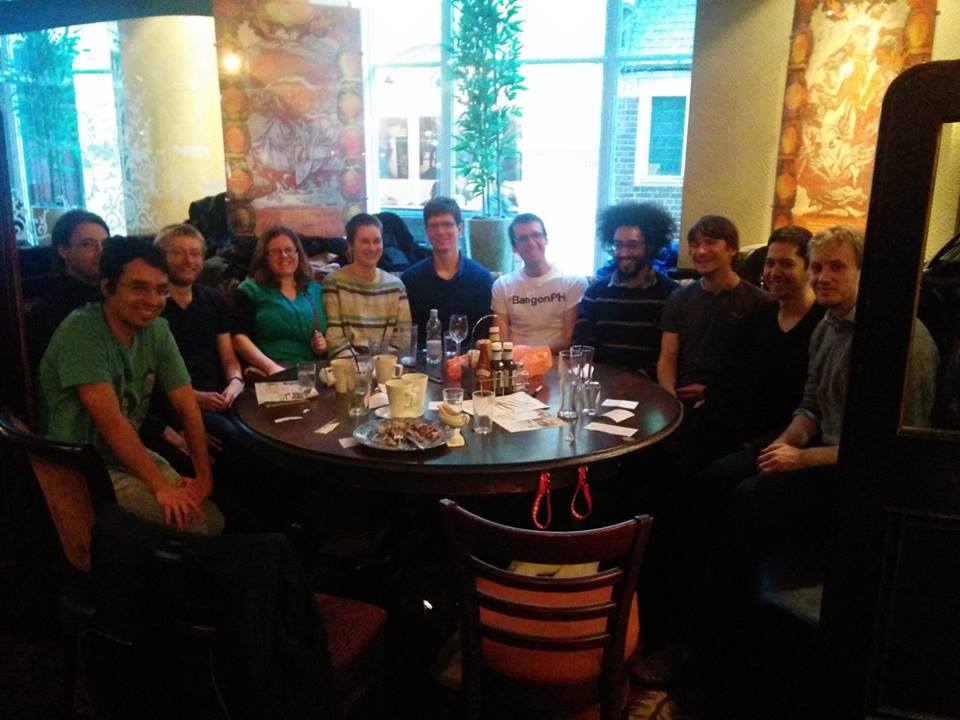 A photo from a (different) recent LW London meetup
Cross-posted to LessWrong
I wasn't going to bother writing this up, but then I remembered it's important to publish negative results.
LessWrong London played a few rounds of paranoid debating at our meetup on 02/02/14. I'm not sure we got too much from the experience, except that it was fun. (I enjoyed it, at any rate.)
Read more…
Posted on 16 February 2014
Tagged:
rationality
A book sometimes cited on LessWrong as recommended reading is E.T. Jaynes' Probability Theory: The Logic of Science. I intend to write a series of posts reading this book, summarizing the key points, and solving the exercises. (There are no solutions in the book.)
The book has over 750 pages. This will take me a long time, if I finish at all. I'm not committing to finishing. For example, if this turns out not to be a thing worth doing, I hope that I will notice that and stop. I'm also not committing to any particular posting rate while I continue.
Read more…
Posted on 02 February 2014
Tagged:
math; reviews
There's a fairly well-known (as these things go) IOCCC entry ("westly.c") to calculate pi. It looks like this:
#define _ F-->00 || F-OO--;
long F=00,OO=00;
main(){F_OO();printf("%1.3f\n", 4.*-F/OO/OO);}F_OO()
{
            _-_-_-_
       _-_-_-_-_-_-_-_-_
    _-_-_-_-_-_-_-_-_-_-_-_
  _-_-_-_-_-_-_-_-_-_-_-_-_-_
 _-_-_-_-_-_-_-_-_-_-_-_-_-_-_
 _-_-_-_-_-_-_-_-_-_-_-_-_-_-_
_-_-_-_-_-_-_-_-_-_-_-_-_-_-_-_
_-_-_-_-_-_-_-_-_-_-_-_-_-_-_-_
_-_-_-_-_-_-_-_-_-_-_-_-_-_-_-_
_-_-_-_-_-_-_-_-_-_-_-_-_-_-_-_
 _-_-_-_-_-_-_-_-_-_-_-_-_-_-_
 _-_-_-_-_-_-_-_-_-_-_-_-_-_-_
  _-_-_-_-_-_-_-_-_-_-_-_-_-_
    _-_-_-_-_-_-_-_-_-_-_-_
        _-_-_-_-_-_-_-_
            _-_-_-_
}
This prints 3.141, but you could get more digits by increasing the size of the circle (and changing the printf call).
Read more…
Posted on 18 January 2014 | Comments
Tagged:
software; silly; math
It feels like most people have a moral intuition along the lines of "you should let people do what they want, unless they're hurting other people". We follow this guideline, and we expect other people to follow it. I'll call this the permissiveness principle, that behaviour should be permitted by default. When someone violates the permissiveness principle, we might call them a fascist, someone who exercises control for the sake of control.
And there's another moral intuition, the harm-minimising principle: "you should not hurt other people unless you have a good reason". When someone violates harm-minimisation, we might call them a rake, someone who acts purely for their own pleasure without regard for others.
But sometimes people disagree about what counts as "hurting other people". Maybe one group of people believes that tic-tacs are sentient, and that eating them constitutes harm; and another group believes that tic-tacs are not sentient, so eating them does not hurt anyone.
What should happen here is that people try to work out exactly what it is they disagree about and why. What actually happens is that people appeal to permissiveness.
Read more…
Posted on 04 January 2014
Tagged:
culture; rationality
Comments elsewhere:
LessWrong
If you hang out on /r/scifi for long enough, you'll hear someone say that Star Wars is not science fiction. It's fantasy in space, or space opera, or whatever, but it isn't science fiction.
(The example that inspired this post, nine months ago, was this thread.)
And, well, they're wrong.
Read more…
Posted on 22 December 2013
Tagged:
rationality
Chicken is a well-known two-player game in which the players get inside different cars, drive towards each other, and hope that the other player swerves out of the way. If both players swerve, they both lose small amounts of charisma. If one player swerves and the other doesn't, the swerver loses a slightly larger amount of charisma, and the non-swerver gains a small amount. If neither player swerves, both lose a large (occasionally fatal) amount of HP, and a small amount of charisma.
It is sometimes said[citation needed] that there is an optimal strategy to playing Chicken: after pointing your car at your opponent, remove your steering wheel. Now you can't swerve, so she knows that she can either swerve or crash.
Hearing this strategy, you head down to your local Chicken field, armed with your trusty screwdriver, and eager for a game. You quickly find an opponent. The two of you perform the traditional squaring-off ritual, enter your respective vehicles, and wheel around to face each other. You take your screwdriver in hand, smile sweetly at your opponent… and realise that she has had the same idea, and is already removing her steering wheel.
Are you still going to remove your own wheel? Or are you going to swerve?
Read more…
Posted on 07 December 2013
Tagged:
game theory; rationality
Human brains are bad at evaluating consequences. Sometimes we want to do something, and logically we're pretty sure we won't die or anything, but our lizard hindbrains are screaming at us to flee. Comfort Zone Expansion (CoZE) is an exercise that CFAR teaches to get our lizard hindbrains to accept that what we're doing is actually pretty safe.
Roughly it involves two steps. One: do something that makes our lizard hindbrains get pretty antsy. Two: don't get eaten as a result.
I organised a CoZE exercise for LessWrong London on Septmeber 1st. We had a total of eight participants, I think I was the only one who'd done any structured CoZE before.
Read more…
Posted on 18 November 2013
Tagged:
rationality
Comments elsewhere:
LessWrong
(Fri, 7 Apr 2017: Importing this post from its original home as a gist.)
I turned my Raspberry Pi into a robot, controlled by a Wii nunchuk. It's surprisingly easy to do - at least, surprisingly to me, who has not previously made a robot. But because it's surprising, it might help others to have a guide, so here one is.
Read more…
Posted on 11 October 2012
Tagged:
software
(Fri, 6 Dec 2013: Importing this post from its original home as a gist.)
The point of this post is an attempt to calculate e to given precision in bash, a challenge given in a job listing that I saw recently. I kind of got nerd sniped. I wrote this as I went along, so there may be inconsistencies.
Read more…
Posted on 16 June 2012
Tagged:
software; math; silly
(Fri, 6 Dec 2013: Importing this post from its original home as a gist.)
The recent post on Hacker News about #! semantics surprised me. I had always assumed that a shebang line like
Would be equivalent to calling
$ /usr/bin/prog -a -b <file>
- but instead, it's
$ /usr/bin/prog '-a -b' <file>
This could only surprise me because I hadn't found out the hard way, so maybe it's not a big deal. Most scripts that I write don't have even a single argument on the shebang line. Most of the rest are Perl scripts, and perl is clever when it comes to parsing a single argument that looks like multiple arguments:
$ echo hi there | perl '-a -n -l -e print $F[0]'
hi
But this behaviour does have consequences, especially with the use of higher-order commands such as sudo, nice and env. For example, the following shebang lines will not work as intended:
#! /usr/bin/sudo -u phil sh
#! /usr/bin/nice -n 19 sh
#! /usr/bin/env perl -n
(Scripts using sudo and nice in a shebang seem unlikely to be distributed, but might find use in site-local maintenance scripts. env can be used to make a script more portable, in case a program isn't in a consistent location across systems.)
Read more…
Posted on 27 July 2010 | Comments
Tagged:
software; silly
